
Vicarii Productions — Story-driven cinema, purpose-led impact. Motivation, truth, humanity.
Who Said That? · Character dossier 003

Socrates

“The most quoted man who never wrote a word.”

A barefoot veteran questioned the confidence of Athens. Twenty-four centuries later, the world confidently quotes him—for words he may never have spoken.

Download the case file
Lifec. 469–399 BCE
PlaceAthens
EvidencePlato · Xenophon · Aristophanes
FormatFive sayings · six rogues
The public figure

Athens saw the nuisance.

An old man stands before a citizen jury. He is poor, plainly dressed, famously unbeautiful and irritatingly calm. He has published nothing, runs no school and takes no fees. Yet Athens accuses him of corrupting the young and failing to honour the city’s gods.

Socrates spent decades stopping people in public places to ask what they meant by courage, justice, goodness and wisdom. Ask for a definition. Test it. Find the contradiction. Begin again. Confidence repeatedly discovered that it had been mistaken for knowledge.

He compared himself to a gadfly sent to sting a large, noble but sluggish horse. Athens eventually decided to swat him.
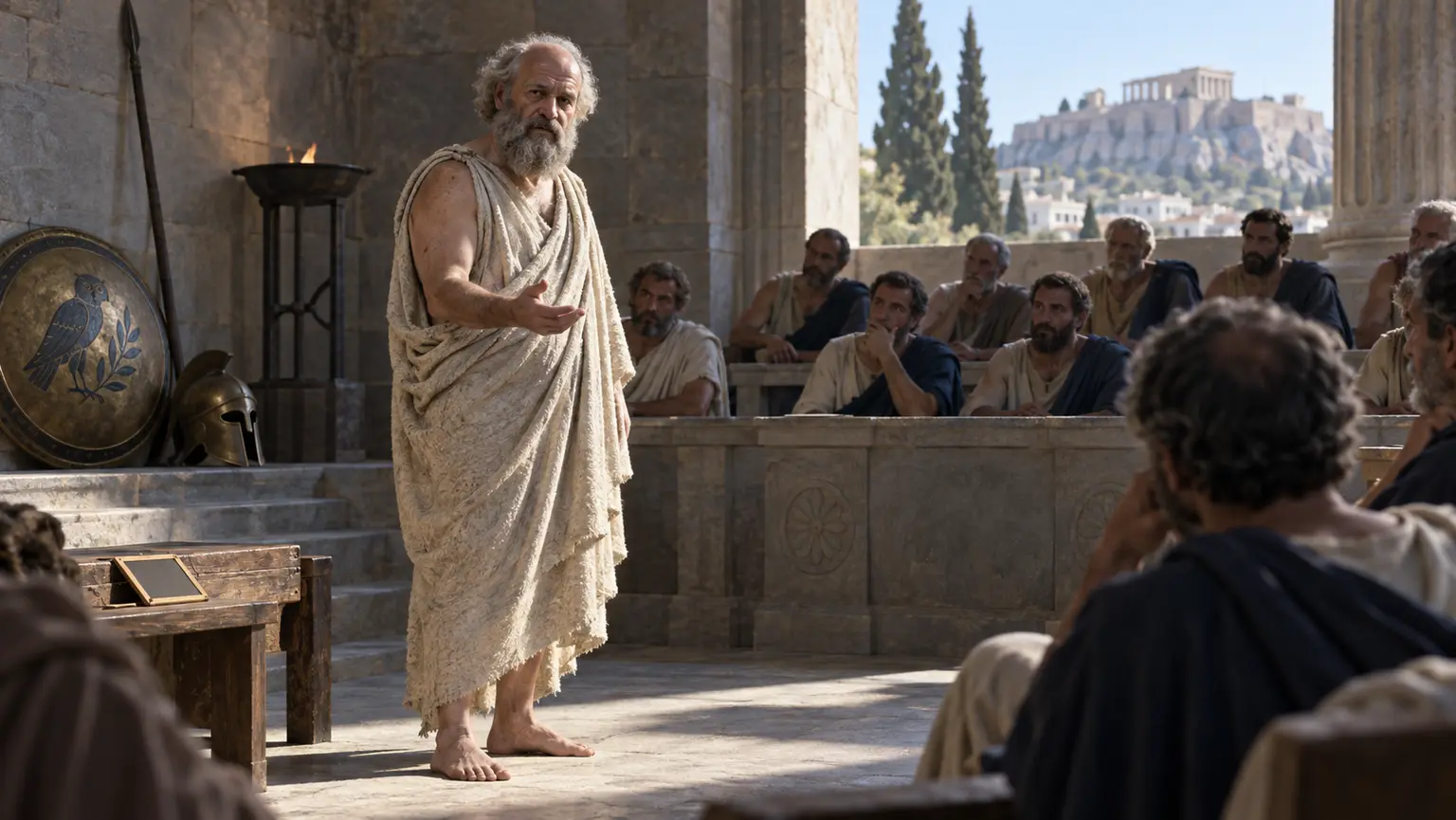
Interpretive scene of Socrates calmly addressing an Athenian jury, with an empty writing tablet and hoplite equipment nearby
Interpretive artwork: the citizen court, empty tablet and soldier’s equipment bring together Socrates’ trial, his unwritten teaching and his military service. It is not documentary evidence.
The private man

Beneath the marble stood a veteran.

The polished philosopher came later. Ancient descriptions give us a stocky, strong man with prominent eyes, a flat nose and heavy lips—more satyr than statesman. He walked barefoot, wore the same rough cloak by day and night, and endured cold, fatigue and wine better than the men around him.

He had served as an Athenian hoplite at Potidaea, Delium and Amphipolis. Under democracy he opposed an unlawful mass proceeding. Under the oligarchic Thirty he refused an order to help arrest Leon of Salamis for execution and simply went home, knowing refusal might kill him.

At his own trial he returned to the soldier’s rule: a man must not desert the post assigned to him merely because death has appeared. His philosophical mission, he said, was another such post.

The quotation audit

What survives?

The translations vary and Plato was not a court stenographer. These verdicts distinguish a strong ancient textual basis from later compression.

Substantially authenticated
“The unexamined life is not worth living.”

In Plato’s Apology, Socrates refuses the possibility of buying safety by remaining silent. Examination is not a decorative motto; it is his answer to a death sentence.

Plato, Apology 38a.
Famous paraphrase
“I know that I know nothing.”

Plato’s wording is more careful: the other man knows nothing but thinks he knows, while Socrates “neither knows nor thinks that he knows.”

Closest source: Plato, Apology 21d.
Authenticated in Plato
“Not life, but a good life, is to be chiefly valued.”

Crito offers escape. Socrates insists that survival is not the deciding principle. A good life must be just and honourable.

Plato, Crito 48b; wording varies by translation.
Authenticated in Plato
“No evil can happen to a good man, either in life or after death.”

He has just been condemned. The claim is moral, not comfortable: another person cannot force the decent man to become unjust.

Plato, Apology 41d.
Authenticated in Plato
“I to die, and you to live. Which is better God only knows.”

The courtroom speech closes not with boastful certainty but with courage, uncertainty and one final question.

Plato, Apology 42a.
The rogues’ gallery

Famous words. Wrong mouths.

These lines sound wise, travel well and look magnificent beneath a marble bust. Evidence is less obliging.

“Be kind, for everyone you meet is fighting a hard battle.”

No ancient source. A close form was printed under the name of Scottish author Ian Maclaren in 1897.

“The secret of change is to focus all your energy on building the new.”

A modern line associated with Dan Millman’s fictional teacher called Socrates—not the Athenian philosopher.

“Strong minds discuss ideas; average minds discuss events; weak minds discuss people.”

No trace in the ancient witnesses. Modern variants circulate under several famous names.

“By all means, marry. If you get a bad wife, you will become a philosopher.”

A splendid joke built from later caricatures of Xanthippe, but unsupported by a dependable early citation.

“Education is the kindling of a flame, not the filling of a vessel.”

The underlying comparison belongs to Plutarch. It is also frequently handed to Yeats.

“There is only one good, knowledge, and one evil, ignorance.”

It resembles Socratic thought, but the tidy wording is not securely located in Plato. Summary, not transcript.

What survives the filter

Not a quotation book. A pattern of conduct.

The imposters gave Socrates better slogans. Socrates gave us the harder task.

  1. Question reputation
    A famous name is not evidence.
  2. Admit the limit
    Not knowing is better than counterfeit certainty.
  3. Test belief in action
    Principle matters most when safety is offered in exchange.
  4. Ask the next question
    The examined life is never quite finished.
Source trail

What can we responsibly claim?

Socrates wrote nothing. Plato, Xenophon and Aristophanes preserve different literary portraits, and exact historical reconstruction is impossible. We therefore label sayings as words attributed to Socrates in an ancient source, not as audio transcripts from 399 BCE.

Read Plato’s Apology
Read Plato’s Crito
Read the Socrates study at Stanford Encyclopedia of Philosophy →

Editorial principle: where certainty ends, the label changes.